Personal · February 8, 2026 · 5 min read
From Uzbekistan to Bern, by Way of Silicon Valley
Bishkek, Odense, Palo Alto, Bern. The route from writing bad scripts in high school to leading a distributed platform team, with the useful parts left in.
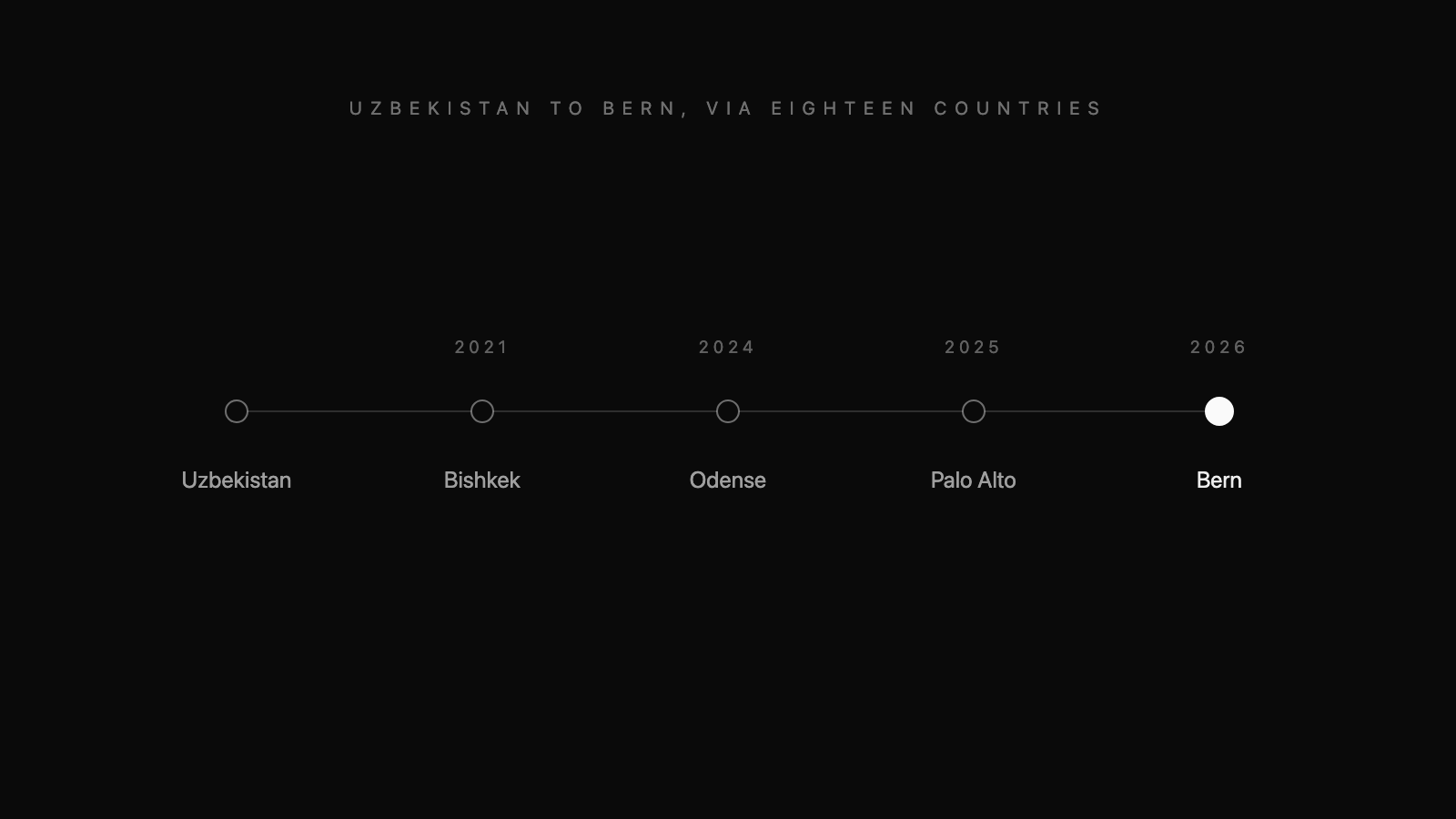
I grew up in Uzbekistan, where there was not much of a tech industry to speak of and no obvious route into one. I started writing code in high school anyway, mostly small scripts and websites, mostly badly, and mostly because I wanted to know how the things on my screen worked.
Today I am a technical lead in Bern. This is the version of the story with the useful parts left in.
Starting out
In 2021 I enrolled at the American University of Central Asia in Bishkek to study software engineering, on a full scholarship from U.S.-CAEF. I graduated in 2025 with a 3.9 GPA. The coursework I actually use is narrower than the transcript suggests: algorithms, system design, and enough machine learning to know what I did not yet understand.
In the spring of 2024 I spent a semester at the University of Southern Denmark working on embedded systems, IoT and robotics. Writing software that moves a physical object is a different discipline from writing software that renders a page. You lose the ability to redeploy your way out of a mistake, and it makes you more careful in ways that carried back into everything else I have written since.
Learning the trade
Before I had any idea what I was good at, I took whatever jobs would have me: Java backends at ONOI Software, Python and Django services at Geek Studios, React and Flask at Rotoy in Denmark. Each one taught me a narrow, concrete thing. How to read a stack trace properly. How to find the query that is actually slow rather than the one that looks slow. How to ship something imperfect on a deadline and not hate yourself for it.
The job that changed my direction was a DevOps internship at Universal Robots in Odense. I built CI/CD pipelines with GitHub Actions, managed Docker and Kubernetes deployments, and automated infrastructure provisioning with Terraform. We cut deployment time by 40 percent and the monitoring work we did lifted uptime by 15 percent.
More useful than either number was the shift in how I thought about the work. Until then I had understood my job as writing code. At Universal Robots it became obvious that the code is the cheap part, and that most of what determines whether software survives contact with production happens around it.
eAdvisor
In 2025 I founded eAdvisor, a platform for automated academic advising, course planning and graduation tracking. The problem was one I had lived through: degree requirements are a dependency graph that students are expected to resolve by hand, from a PDF, under time pressure, with real consequences for getting it wrong.
I built it with Django, React, PostgreSQL and an NVIDIA RAG pipeline for the advising queries. It was selected as one of the top ten startups out of 150 applicants for the Silicon Valley Immersion Program, and shortly after we raised 60,000 dollars in SAFE investment from a Palo Alto venture firm.
Running it taught me more about engineering judgement than any single job has. When you are the one paying for the servers, you stop having opinions about architecture and start having budgets.
Eighteen countries
I have been to eighteen countries so far. Some for a week, some for months, a few I have lived in properly.
The practical effect on my work is that I have had to explain technical decisions to people who did not share my first language, my assumptions, or my sense of what was obvious. That is a skill, it is learnable, and it turns out to matter more in a senior role than most of the things I spent my twenties optimising.
What I am doing now
I lead development on a distributed Next.js and Kubernetes platform for a client in the Netherlands, and mentor the junior and mid-level engineers on that team. Alongside it I am doing an MSc in computer science at the University of Bern, specialising in machine learning, which is my attempt to close the gap between using these systems and understanding them.
If you are building something difficult, or you want to argue with anything on this site, my inbox is open. You can find me on GitHub and LinkedIn, or through the contact page.